Law
Faculty of Law
Photo: UHH/Denstorf
8 June 2026
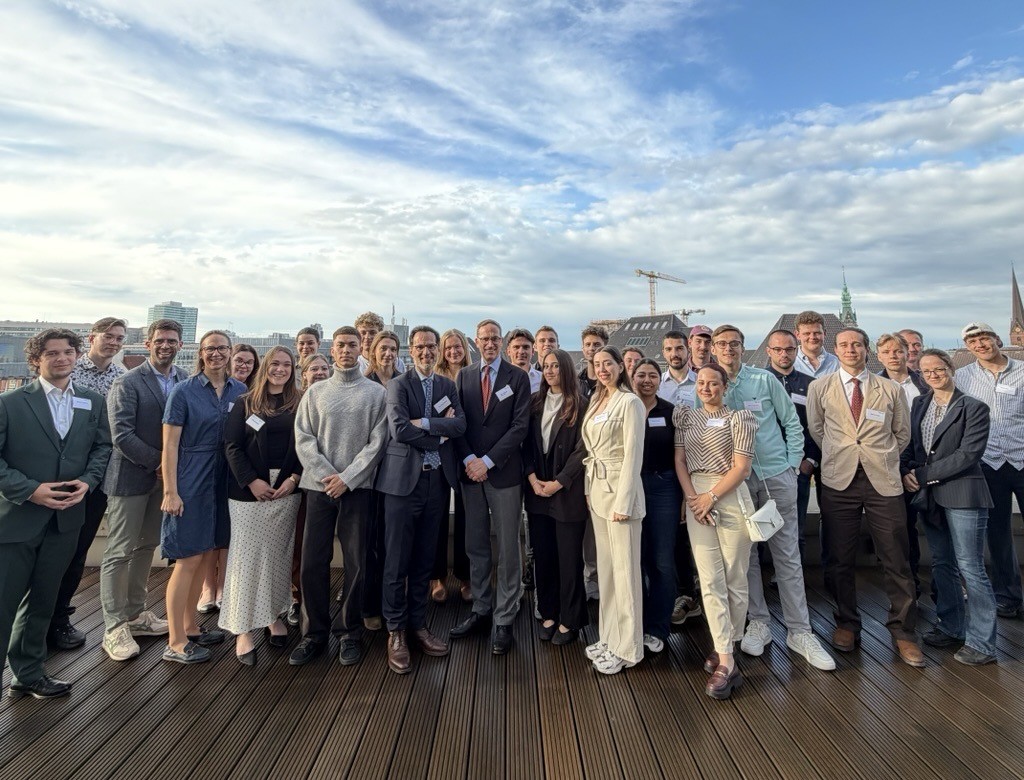
From 1 to 5 June 2026, the Faculty of Law at the University of Hamburg hosted the Erasmus+ Blended Intensive Programme (BIP) "International Commercial Arbitration in Times of Global Challenges". More than 20 students from seven universities – the University of Silesia in Katowice, the University of Kragujevac, the Open University of Cyprus, the Riga Graduate School of Law, Eötvös Loránd University Budapest, the Universidad de Alcalá, and the University of Hamburg – came together for five intensive and varied days in Hamburg.
What sets a BIP apart from a regular course is the combination of academic engagement and genuine Erasmus encounter. Already on Monday morning, a Human Bingo icebreaker got participants from different countries talking to one another – and the momentum never really stopped. From the start, the atmosphere in the group was open, curious, and warm.
The program had actually begun back in late April: during an online phase, students received an introduction to the subject and formed international teams. Over the weeks leading up to the Hamburg week, these teams independently developed scholarly questions – on the impossibility of contractual performance in comparative perspective, on changed circumstances across legal systems, on the role of sanctions under the CISG, and more. On Thursday, 4 June, they presented and defended their findings in front of the full group – one of the highlights of the week.
The academic quality of the program rested on a group of engaged lecturers and contributors from both the scholarly and the professional worlds. Through lectures, the interactive "Arbitration Café", and an evening talk, they offered current and practically grounded insights into international arbitration law. Warm thanks go to Dr. Malgorzata Pohl-Michałek (University of Silesia), Dr. Chrysthia Papacleovoulou (Open University of Cyprus), Prof. Dr. Aleksandrs Fillers (Riga Graduate School of Law), and Dr. Nicole Grohmann (Hanefeld Legal) for their lectures, and to Dr. Edward Rensmann (Hanefeld Legal), Kasvi Thakkar (Manner Masser), Niklas Holz (currently legal clerk at Bird & Bird LLP), Dr. Inken von Gadow and Dr. Nicolas Hagge (Hanseatic Higher Regional Court), and Prof. Dr. Sylvain Bollée (Université Paris 1 Panthéon-Sorbonne) for their contributions to the wider programme. The BIP was academically led throughout by Prof. Dr. Wolfgang Wurmnest, who also chaired the student presentations.
The week closed on Friday, 5 June, with the conference "International Commercial Arbitration in Times of Global Challenges", which the BIP students attended as an engaged audience – giving them direct access to current scholarly and professional debate. The conference was organised and generously supported by the Hamburg Arbitration Circle (HAC) under the leadership of Prof. Dr. Antje Baumann, who gave the closing day both a professional framework and financial backing.
Alongside the academic programme, the week left plenty of room for genuine Erasmus moments: the welcome dinner overlooking the Elbe and the harbour, the harbour boat tour on Tuesday, the walk through Planten un Blomen and visit to the Hanseatic Higher Regional Court on Wednesday, the evening reception at RSM Ebner Stolz on Thursday – hosted by Dr. Christian Steger-von Förster – and finally the farewell dinner on Friday evening. Students from seven different universities became, by the end, one group.
Student feedback was very positive across the board: the program was rated as excellent overall, the exchange as enriching, and the combination of academic depth and personal encounter as particularly successful.
A great deal of credit for that success goes to Andrea Hearst and Dr. Stine von Förster from the Faculty's International Office, who organised the BIP from the very first planning stage through to the final evening and were present on the ground every single day to keep things running smoothly.
The Faculty of Law extends its heartfelt thanks to everyone involved – the lecturers and contributors, the HAC, the partner universities, and above all the participating students who made this week truly memorable.