Law
Faculty of Law
Photo: UHH/Denstorf
29 September 2026
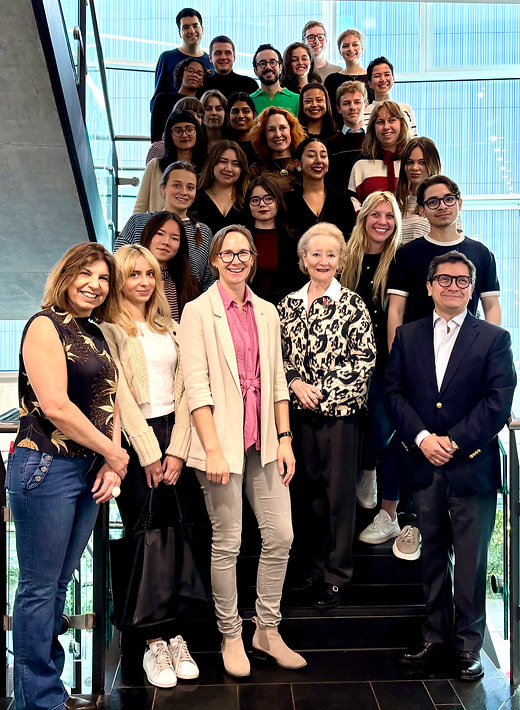
With the conclusion of the Hamburg program weeks (14–25 September 2026), this year's International Law Plus (IL+) has reached its culmination. Under the title "Love, Law and Identity", the law faculties of the University of Hamburg, the Universidad de Chile, and the Universidade de São Paulo jointly organised an international seminar placing family law, gender identity, and comparative law at its centre.
Three Phases, Two Continents
The program launched in April 2026 with on-site phases at the partner universities – one group of Hamburg students travelled to Santiago de Chile, another to São Paulo. From the outset, both groups engaged with the seminar's themes in the context of Latin American legal systems and societies.
During the subsequent four-month online phase, students from Hamburg, Chile, and Brazil worked together in international teams and co-authored seminar papers on comparative family law questions.
Academic Contributions: Family Law between Culture, History, and the Present
The seminar theme "Love, Law and Identity" ran as a common thread throughout the Hamburg program: what role do cultural and historical contexts play in the development of family law – and how do different legal systems respond to contemporary realities of family life and gender identities?
Over the two weeks at the University of Hamburg, Henrike von Scheliha (Bucerius Law School) spoke on reproductive freedom and justice, Saskia Lettmaier (University of Hamburg) on the history of divorce law in the 18th century, Anika Börjesson on women's shelters in Hamburg, Miria Lottmann (Hamburg Police) on hate crime against LGBTI* individuals, and Alexander Seiler and Mia Ewert (BWFG) on Hamburg's diversity policy within the Rainbow Cities Network. Florian Vogelsang (Hanseatic Higher Regional Court) guided the group through the OLG building and led an engaging discussion on family law issues in judicial practice. Teresa Cristina Cabral Santana (Universidade de São Paulo) and Luciana Paiotti (Brazilian judge and member of the Coletivo Sankofa de Magistradas, a collective of Brazilian women judges committed to diversity and equality in the judiciary) broadened the perspective with a contribution on domestic violence against women from a Brazilian standpoint. Julia Richter (Bucerius Law School) prepared students for their oral presentations in a dedicated session.
One of the highlights was the day at the Max Planck Institute for Comparative and International Private Law on 22 September 2026. Alongside a library tour led by Elke Halsen-Raffel (MPI), the day offered space for academic contributions that deepened the seminar's themes: Susanna Roßbach (MPI) spoke on "Queering Motherhood", Christopher Reibetanz (MPI) on non-marital cohabitation in cross-border contexts, and Luana Matoso (MPI) introduced the Centre of Expertise on Latin America. The group was accompanied that day by María Teresa Infante (Universidad de Chile, Judge at ITLOS), who has been closely connected to the program over many years and engaged in lively conversation with students from all three countries.
Following the visit to the Neuengamme concentration camp memorial, Ansgar Karnatz and Jona Diwiak led a reflection and input session on the persecution of queer people under National Socialism, placing the experience in a scholarly context.
Student Presentations: Comparative Law in Practice
The academic core of the Hamburg weeks was formed by twelve oral final presentations in which the international teams presented and discussed their research papers. Topics ranged from maintenance and divorce questions with a cross-border dimension, through the protection of domestic violence victims across different family constellations, to questions surrounding same-sex parenthood, multi-parenthood, and the recognition of rainbow families in private international law. Several teams examined how differently Germany, Chile, and Brazil respond to family realities beyond the traditional model – and where the limits of statutory protection regimes lie. The presentations underlined how productive scholarly exchange between three legal systems and three university cultures can be.
Encounter as Program
International Law Plus is, however, far more than a purely academic program. The canoe trip on the Alster with the University Sports Centre Hamburg at the opening, the harbour tour by HVV ferry, a walk through Planten un Blomen and a visit to the Grüner Bunker on Heiligengeistfeld, the memorial visit to Neuengamme, and finally the farewell dinner at Beach Club Dock 3. Over two weeks, students from three countries and three legal systems became one group, and a university seminar became an intensive international exchange experience. The program opened up perspectives beyond the legal field, built understanding for different social and personal realities of life, and conveyed to the lawyers of tomorrow something no textbook can teach: empathy as a core legal competence.
Academic Leadership and Organisation
This year's program was led by Konrad Duden (University of Hamburg), Rodrigo Contreras (Universidad de Chile), and Sheila C. Neder Cerezetti (Universidade de São Paulo). Andrea Hearst and Stine von Förster from the International Office of the Faculty of Law played a central role in making IL+ 2026 possible – from securing funding and coordinating the preparatory phase across two continents to accompanying the program on the ground throughout.